 Continue with Facebook
 Continue with Google
 Continue with Apple
A Night in the French Chateau
Details
Anya Owens full profile / Solo Piano / 1 musician
Full program notes
A Night in the French Chateau
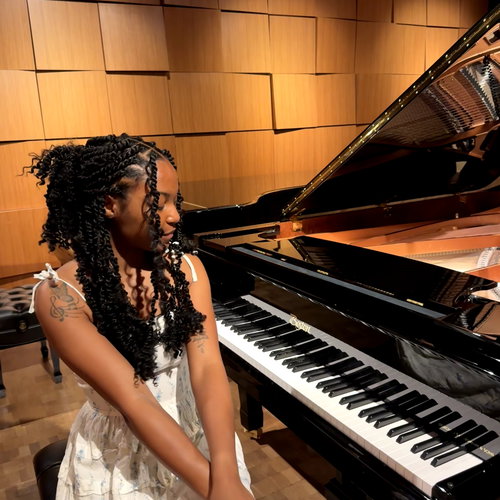
Anya Owens, Piano
Clair de Lune C. Debussy
Préludes, Book 1 C. Debussy
VIII. La Fille aux cheveux de lin
A La Manière de Borodine M. Ravel
Préludes, Book 2 C. Debussy
V. Bruyères
Sonatine M. Ravel
I. Modéré
II. Mouvement de Menuet
III. Animé
Intermission
Arabesque No. 1 C. Debussy
Préludes, Book 1 C. Debussy
V. Les Collines d’Anacapri
X. La Cathédrale engloutie
L’Isle joyeuse C. Debussy
Historical context
A Night in the French Chateau is a concert experience meant to transport listeners to 20th century Paris during the height of the musical Impressionist period. Originally emerging as an artistic rebuttal against realism, impressionism portrays the impression of an object or action rather than the precise details that form the larger pictures from older eras of art. Painters like Claude Monet and Pierre-Auguste Renoir were leaders of this art style, and their works are often paired with Impressionistic compositions as visual representations of the style. Musical impressionism developed a few years later, pioneered by Claude Debussy, as a response to the rigid rules of Romanticism (the era directly preceding Impressionism). Impressionist paintings and music both tend to adopt a blurry, atmospheric quality, and reject rigid requirements of form and precision. For A Night in the French Chateau, I invite listeners to allow themselves to succumb to their imagination and see where their mind goes as the music unfolds.
Claude Debussy (1862-1918)
Debussy, the French composer and pianist, found much of his inspiration in the works of Monet and Renoir, French Symbolist poets like Verlaine and Mallarme, and world music that includes Javanese gamelan. He’s responsible for many beloved staples in classical music, much of which are interspersed throughout this program. We are greeted with two of these classics: Clair de Lune and La Fille aux cheveux de lin (The Girl with the Flaxen Hair), both serene and tender in nature. Later in the program, after intermission, we will hear his First Arabesque, one of his earliest and most commonly played compositions. Bruyères, Les Collines d’Anacapri, and La Cathédrale engloutie (The Sunken Cathedral) are all preludes that pushed normal conventions of earlier classical music. These atmospheric freeform preludes are meant to paint pictures with notes. The finale, L’isle joyeuse, is one of Debussy’s most formidable piano works. It takes inspiration from gamelan with its use of the whole tone scale and multiple overlapping rhythms.
Maurice Ravel (1875-1937)
Ravel, revered for his innovative and imaginative compositions, was not the best pianist. This quirk of his makes for a more grueling learning process, as many of his pieces were not physically tried out before being published. He doesn’t take up much space in the program, but the two pieces I’ve included are indicative of his compositional style that favors complex harmonies and jazz influences. The first, A La Manière de Borodine (In the style of Borodin), is a musical tribute to Alexander Borodin, a Russian pianist considered by Ravel to be a predecessor to the Impressionistic style. His Sonatine was written for a composing competition (Ravel was disqualified) and is a loose example of theme and variations — he develops the falling fourth theme from I. Modéré throughout the rest of the piece. This was one of the pieces Ravel performed frequently, despite the fact that the third movement (III. Animé) was too difficult for him to play.
Videos from this player

