 Continue with Facebook
 Continue with Google
 Continue with Apple
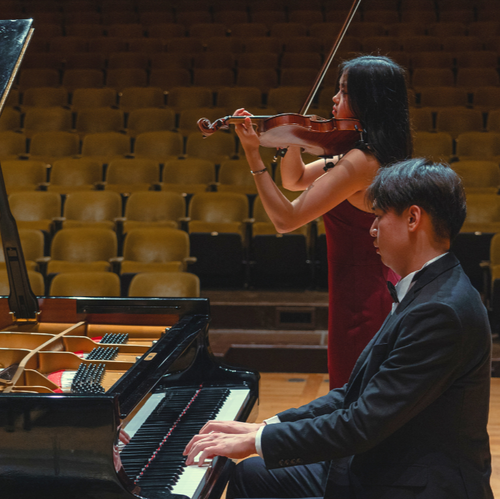
Violin and Piano Recital
Details
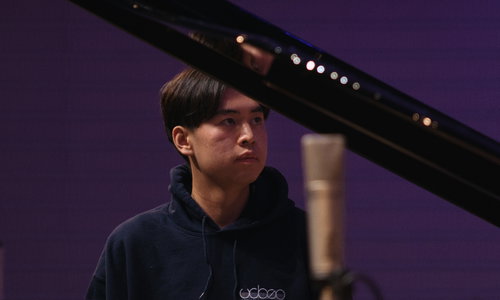
Vanness Yu & Phoebe Wu full profile / Violin and Piano / 2 musicians
Other players: Phoebe Wu
Full program notes
Amy Beach - Op. 23 - Romance for Piano and Violin (1893)
In all the violin/piano repertoire, no piece encapsulates the unfiltered rawness of love quite as much as Amy Beach’s Romance. A heartaching push and pull can be heard with the passing back and forth of the main theme, the emotional turbulence heightened by Beach’s post-romanticism harmonic language. She is a part of what we call the “Second New England School” of music, and was a pioneer for the American voice in classical music.
Olivier Messiaen - Theme et Variations (1932)
Messiaen’s music is heavily inspired by his chromesthesia, a condition in which sound would trigger the bearer to perceive certain colors. Combined with his devout Catholicism and compositional approach of the yearn for beauty, five variations on a galactical and timeless theme were born. He premiered and performed this piece often with Claire Delbos, his first wife, who unfortunately passed away early in her life.
Ludwig van Beethoven - Violin Sonata No. 9 Op. 47 (1803) “Kreutzer” 1st movement
Beethoven's second to last violin sonata, and the last violin sonata he would write for 10 years. The piece was first dedicated to his old friend and British violinist George Bridgetower, but eventually re-dedicated to another famous violinist Rudolph Kreutzer. The first movement is the epitome of Beethoven's "middle period" of his compositional timeline, a work filled with tension, heroism, and an intensity of emotion. Virtuosic runs pass between the piano and the violin creating so much a strong pulse of energy that fuels the continual motion of the work.
Dvorak/Kriesler - Songs My Mother Taught Me (1914)
A transcription of the Czech composer Antonin Dvorak's song, by the violinist Fritz Kriesler. Originally a song for voice and piano from his song cycle "Gypsy Songs", it talks about the love of a mother for her child, "songs she taught me in the days long vanished".
Ennio Morricone - Cinema Paradiso Love Theme (1988)
The main theme from the famous movie Cinema Paradiso. A lovely tune, encapsulating the love and friendship between a young boy and an aging projectionist. This is an arrangement found online, turning the beautiful tune into a duet between violin and piano.
Johann Sebastian Bach - Violin Sonata No. 2 in a minor BWV 1003 - “Andante”
A part of a set of six sonatas and partitas for solo violin, Violin Sonata No. 2 in A minor, BWV 1003 by Johann Sebastian Bach represents a pinnacle of the instrument’s contrapuntal possibilities through extensive implied polyphony. The Andante unfolds as a lyrical meditation, weaving a gently flowing melodic line above a steady, pulsing accompaniment reminiscent of one’s heartbeat. Within this single line, Bach creates the illusion of multiple voices, balancing structural clarity with subtle emotional depth.
Johannes Brahms Op. 117 No. 2 Intermezzo in B-flat minor
Brahms once told a friend that the Op. 117 pieces were “three lullabies of my grief”, and within his set of three short piano pieces published in his 3 Intermezzi Op. 117, No. 2 in particular, is the most bizarre. The central theme of the piece is a simple two note, half step idea, that occurs throughout the entire piece within a longer lamenting melody. The middle section of the piece is simply an augmentation of the two note motif. Not only is this piece a great representation of thematic transformation at its finest, but also of the beauty in grief.
Gershwin/Frolov Fantasy on Themes from Porgy and Bess (1987)
Porgy and Bess is a landmark folk opera by George Gershwin, pioneering the use of an all-Black cast and blending elements of jazz, blues, and spirituals with Western classical traditions. Igor Frolov’s arrangement for violin and piano interprets several famous melodies from the opera through violinistic virtuosity. Despite incorporating new material and demanding technicalities, Frolov preserves the stylistic integrity of the opera, especially through idiomatic embellishments and Gershwin’s distinctive blues-infected harmonic language.
Ponce/Heifetz - Estrellita (1927)
Superstar violinist Jascha Heifetz loved to play encores in the country he was performing in, and found himself in Mexico City without an encore. Luckily for him, while sitting at a coffee shop, he overheard a singer perform the Manuel Ponce arrangement of the folk tune “Estrellita”. He hurriedly scribbled down the chord progression and composed a transcription the very next day, and performed it that evening. The singer yearns for love, seeking out the stars for answers, with melodies that soar above into the night sky.
Historical context
Our music is deeply rooted in the traditions of Western Classical Art Music, just as our instruments and training are. However, what makes music special, is that the music itself might have an origin, but the musician as a medium themselves has so much to say, and has experiences that have been shaped by the world outside of music, especially in this age of the internet. Our interpretations, performance, and spoken words about this piece have all been shaped by our own identity history, as we intermingle the histories of the music and the musician.
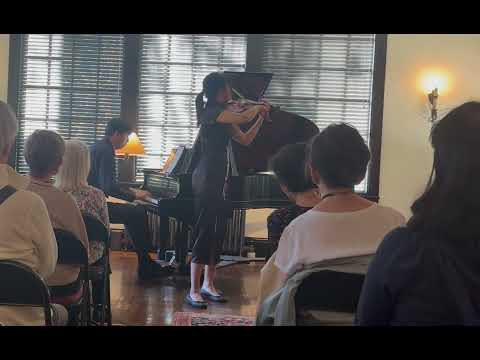
Videos from this ensemble

Other programs from this ensemble
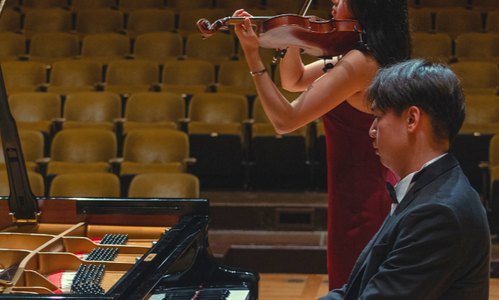
- Musician profile: Vanness Yu & Phoebe Wu
-
 Instruments:
Violin and Piano
Instruments:
Violin and Piano
- Musicians: Vanness Yu, Phoebe Wu
-
Full Length Violin and Piano Program
- Musician profile: Vanness Yu & Phoebe Wu
-
Instruments:
Violin and Piano
- Musicians: Vanness Yu, Vanness Yu and Phoebe Wu
-
- Musician profile: Vanness Yu & Phoebe Wu
-
Instruments:
Violin and Piano
- Musicians: Vanness Yu, Phoebe Wu