
Piano and Violin Concert
Diamond Heights, San Francisco, Ca.
Sun, February 22, 2026, at 3:00 PM, PST

- Bring your own drinks
- Alcoholic and non-alcoholic drinks provided
-
Wheelchair access
- Not wheelchair accessible
-

- Some stairs may be present in the space
-

- Click here for more accessibility details

This is a groupmuse
A live concert in a living room, backyard, or another intimate space. They're casual and friendly, hosted by community members.
Host
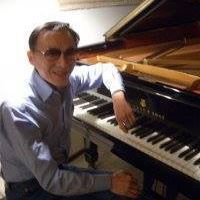
Come and hear 2 wonderful young musicians perform a wide range of European and Europe-influenced Classical music in a beautiful setting featuring spectacular city views at the top of Diamond Heights. Light refreshments, wine and cheese will also be served.
What's the music?
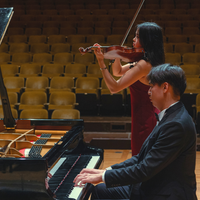
Amy Beach Op. 23 - Romance for Violin and Piano (1893):
In all of the violin/piano repertoire, no piece encapsulates the unfiltered rawness of love quite as much as Amy Beach’s Romance. The push and pull effect can be heard with the passing back and forth of the main theme, and the emotional turbulence is heightened by Beach’s post-romanticism harmonic language. She is part of what we call the “Second New England School” of composition, and was a pioneer for the American voice in classical music.
Antonin Dvorak Op. 11 - Romance in F minor (1879):
A distant cousin to the Romance of Amy Beach, Dvorak’s wintry Romance brings listeners to a darker place. The composer finds inspiration from within: taking a second movement of a previous string quartet of his own and reshaping it. A snowy forest of sound: portly pizzicatos are raindrop-esque, the melodies always yearning for warmth. Surging runs in the development section erupt explosively, until the snowstorm simmers back down to a gentle, pleasant, powdery fall. The piece ends in a peaceful major key, a gesture of resolution.
Olivier Messiaen - Theme et variations (1932):
A work composed for his first wife Claire Delbos, a violinist whom he would premiere and perform with publicly many times. Messiaen’s music is heavily inspired by his chromesthesia, a condition in which sound would trigger the bearer to perceive certain colors. Combined with his devout Catholicism and love for nature and the tunes of birdsongs, five variations on a galactical and timeless theme were born.
Ennio Morricone - Cinema Paradiso Love Theme (1988): The main theme from the famous movie Cinema Paradiso. A lovely tune, encapsulating the love and friendship between a young boy and an aging projectionist. This is a transcription found online, turning the beautiful tune into a duet between violin and piano.
Antonin Dvorak/Kriesler - Songs My Mother Taught Me (1914): A transcription of Dvorak's song, by the violinist Fritz Kriesler. Originally a song for voice and piano from his song cycle "Gypsy Songs", it talks about the love of a mother for her child, "songs she taught me in the days long vanished".
Ludwig van Beethoven - Violin Sonata No. 9 Op. 47 "Kreutzer”" (1803): Beethoven's last violin sonata, the piece was first dedicated to his old friend and violinist George Bridgetower. However, they had a big falling out right before the premiere, and out of pettiness, Beethoven renamed it to the "Kreutzer", after another famous violinist and Bridgetower's rival at the time. The first movement is the epitome of Beethoven's "middle period" of his compositional life, a work filled with tension, heroism, an intensity of emotion. The virtuosic passages pass between the piano and the violin create so much energy, that he uses to fuel the continual motion of the piece.
Manuel Ponce - Estrellita arr. Heifetz (1912):
While on tour, violinist Jascha Heifetz sat at a coffee shop in Mexico when he heard a singer perform the Manuel Ponce arrangement of the folk tune “Estrellita” for voice and piano. Ponce wrote many folk-tune transcriptions, Estrellita (translated into My Little Star) being one of the most famous. The singer serenades the little stars in the night sky, asking for their love. Heifetz’s transcription shifts the piece into a different key, heightening the yearning desire. The harmonic language is stylish and chic, providing a groundedness for large interval leaps that search for answers. glancing up at the stars for assurance.
Where does this music come from?
Our music is deeply rooted in the traditions of Western Classical Art Music, just as our instruments are. However, what makes music special, is that the music itself might have an origin, but the musician themselves have so many life experienced that have been shaped by worldwide influences, especially in this age of the internet. Our interpretations, performance, notes and spoken words about this piece have all been shaped by our own history, as we intermingle the histories of the music and the musician.
Location
Exact address sent to approved attendees via email.
This is a groupmuse
A live concert in a living room, backyard, or another intimate space. They're casual and friendly, hosted by community members.
Host
Attendees

 Continue with Facebook
 Continue with Google
 Continue with Apple
Comments
Comment sections are only for participants.