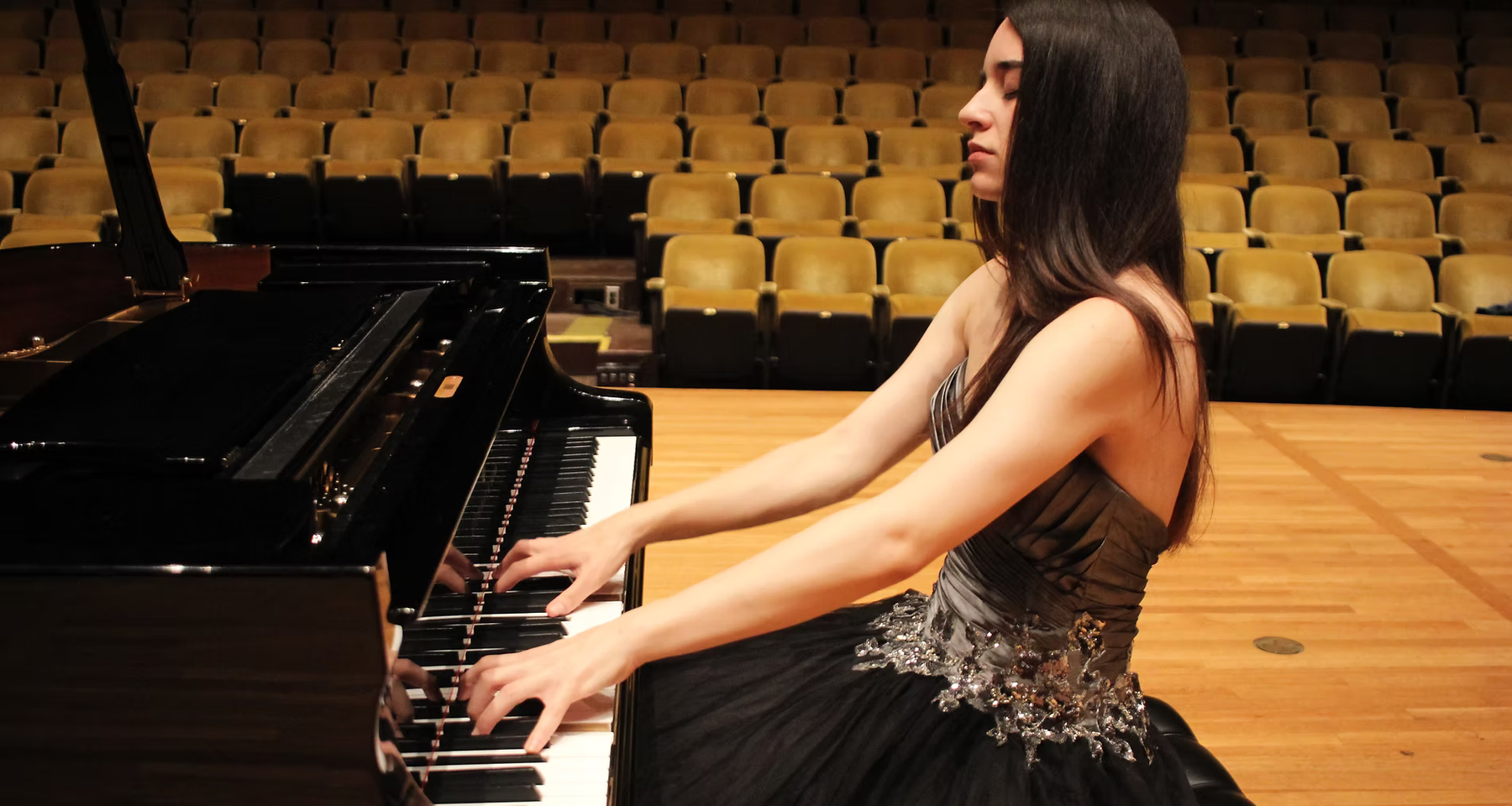
Theodora Serbanescu-Martin: Pianistic Invocations: Liszt's Poetic Harmonies
Flatiron, New York
Mon, March 9, 2026, at 7:00 PM, EDT
- Alcoholic and non-alcoholic drinks provided
-
Wheelchair access
- Wheelchair Accessible

This is a groupmuse
A live concert in a living room, backyard, or another intimate space. They're casual and friendly, hosted by community members.
Host

7 PM Doors & Pre-Reception
8 PM Recital
9:30 PM Post-Reception
Theodora Serbanescu-Martin: Pianistic Invocations: Liszt's Poetic Harmonies
Gotham Arts in collaboration with Groupmuse is delighted to present Pianistic Invocations: Liszt's Poetic Harmonies, an intimate private solo recital by pianist Theodora Serbanescu-Martin featuring the entirety of Liszt's Harmonies poétiques et religieuses, one of the most profound and personal cycles in the piano repertoire. Inspired by Romantic poetry and shaped by Liszt's fascination with ritual, spirituality, and memory, these works explore prayer, mourning, and devotion as lived emotional experiences rather than religious doctrine. Love — of the divine, of the dead, of the absent — runs through the music as a sustaining force.
Blending performance with brief spoken context, the evening is designed as a guided listening experience that invites reflection and conversation. Heard in an intimate salon setting, Liszt’s music becomes a space of invocation and transformation — where sound serves as a bridge between love and loss, solitude and connection.
Wine will be served.
Program
LISZT Harmonies poétiques et religieuses, S. 173
1. Invocation
2. Ave Maria
3. Bénédiction de Dieu dans la solitude ("The Blessing of God in Solitude")
4. Pensée des morts ("In Memory of the Dead")
5. Pater Noster
6. Hymne de l'enfant à son réveil ("The Awaking Child’s Hymn")
7. Funérailles (Funeral)
8. Miserere, d'après Palestrina (after Palestrina)
9. La lampe du temple (Andante lagrimoso)
10. Cantique d'Amour ("Hymn of Love")
About the Artist
Watch Theodora perform Brahms' Klavierstücke, Op. 116 on a historic Streicher piano from 1857
Theodora Serbanescu-Martin is a pianist, musicologist, and interdisciplinary scholar whose work bridges performance, literary studies, material culture, and the history of embodiment. She is completing her PhD in Music and Sound Studies at Cornell University (degree expected spring 2026), and holds dual BA degrees in Music and English, with a minor in German Studies, from the University of California, Berkeley.
Her doctoral dissertation, Fashionable Concealments: Myth, Material, and Method in Nineteenth-Century Pianism, reconstructs the piano as a cultural instrument situated at the intersection of fashion, discipline, literature, and technique. Moving beyond genealogical narratives of virtuosity, the project examines how bodies, clothing, and technologies shaped Romantic ideals of expression, authenticity, and labor. This research forms the basis of her forthcoming book project, Fashioning Pianism: The Media of Romantic Virtuosity. Her scholarship will also appear in the Oxford Handbook of Arrangement Studies (Oxford University Press), with a chapter titled "Effortful Reductions: Brahms’s Piano Transcriptions and the Notation of (Dis)Ability," and in the Nineteenth-Century Music Review.
At Cornell, Theodora served as assistant curator for the exhibition Sounding Fashion and was the organizer of the conference-festival Performing Clara Schumann. Her research has been supported by the American Musicological Society's Elizabeth C. Bartlet Fund, the Institute for European Studies, the Timothy Murray Fellowship, and the Cornell Council for the Arts. She regularly presents lecture-recitals and conference papers that integrate historicist reading, performance analysis, and archival work.
As a performer, Theodora identifies as a "Romantic pianist" — a term she uses to describe an approach grounded in nineteenth-century aesthetics of flexibility, virtuosity, improvisation, and expressive risk, while remaining critically aware of Romanticism's afterlives and ideological consequences. Her performances do not claim historical "authenticity," but instead treat Romantic materials as living, mediated practices shaped by context, technology, and embodiment. She is particularly interested in how visual, literary, and material dimensions—dress, gesture, space, and staging—shape musical meaning.
She has appeared internationally throughout Europe and the United States and has performed with ensembles including the UC Berkeley Symphony Orchestra, the Peninsula Symphony, the Saratoga Symphony, the Lublin Philharmonic, and the Kostroma Symphony with repertoire such as Brahms's Second and Prokofiev's Second concertos, as well as extra-canonical repertoire. Currently, she is working on a recording and critical edition of Hélène de Montgeroult's seminal but forgotten method Cours complet pour l’enseignement du forte piano, while preparing performances of Marie Jaëll's rarely heard first concerto, Liszt's De Profundis psalm-concerto, and other virtuoso repertoire including Alkan. Her performance work has been recognized with prizes at competitions such as the International Los Angeles Liszt Competition, IPC Sussex, and MTAC competitions, and with scholarships at festivals such as the Dublin International, American Fine Arts Festival, and Freiburg International, and the California Summer Music chamber festival. She collaborates regularly with historical keyboard collections, including Cornell's Center for Historical Keyboards, the Westfield Center, and the Ira F. Brilliant Beethoven Center, and is currently in town for the event The Sociable Fortepiano, where she is presenting work on nineteenth-century finger-strengthening devices, Romantic virtuosity, and fashion at the keyboard.
What's the music?

Liszt, Harmonies poétiques et religieuses, S. 173 (written/reworked in 1847, published 1853), complete:
- Invocation
- Ave Maria
- Bénédiction de Dieu dans la solitude ("The Blessing of God in Solitude")
- Pensée des morts ("In Memory of the Dead")
- Pater Noster
- Hymne de l'enfant à son réveil ("The Awaking Child’s Hymn")
- Funérailles (Funeral)
- Miserere, d'après Palestrina (after Palestrina);
- La lampe du temple (Andante lagrimoso)
- Cantique d'Amour ("Hymn of Love")
Where does this music come from?
Composed and repeatedly reworked across the 1830s and 1840s, Liszt’s Harmonies poétiques et religieuses—one of the most significant cycles for solo piano (and over ninety minutes in its complete form)—stands at the spiritual and poetic center of his output. The title is borrowed directly from a collection of poems by Alphonse de Lamartine, whose lyrical, metaphysical, and politically liberal writing deeply shaped Liszt’s imagination. Like Lamartine’s verse, this music meditates on solitude, prayer, mourning, and transcendence, offering an inward spirituality rather than doctrinal belief.
Liszt worked on these pieces over many years, revising earlier versions into the unified cycle published in 1853. Several movements reflect periods of retreat and contemplation during his time in the Polish countryside at Woronińce, while others respond to personal loss and to Romanticism’s deep preoccupation with death, memory, and the sacred. The result is music that inhabits a charged space between devotion and doubt—rooted in Catholic ritual yet infused with metaphysical questioning, humanitarian idealism, and a fascination with what survives beyond the visible world.
At the heart of this cycle is not only religious devotion, but devotion as such: an affective orientation toward something absent, distant, or only partially knowable. Prayer here functions as love and longing rather than doctrine; repetition becomes a form of waiting, and sound itself becomes a means of address—calling toward what cannot be possessed, revived, or fully named. Liszt’s sacred language is inseparable from his language of love, whether remembered, deferred, or sustained across absence and time.
This concert is offered in that spirit. It is dedicated to love in its many Romantic guises: love of the divine, love of the dead, love of the distant beloved, love as fidelity carried across loss. In Bénédiction de Dieu dans la solitude, stillness becomes an ethical and emotional stance; in Pensée des morts, remembrance takes the place of presence; in Pater Noster, collective prayer turns into intimate invocation. These works ask for tender attention, patience, and vulnerability.
Together, they present Liszt far beyond his reputation as a virtuoso showman: as a poetic thinker at the keyboard, using sound as ritual—at once prayer, memory, and spell—to explore belief, longing, and the sustaining power of love itself.
Location
Exact address sent to approved attendees via email.
This is a groupmuse
A live concert in a living room, backyard, or another intimate space. They're casual and friendly, hosted by community members.
Host
Attendees





 Continue with Facebook
 Continue with Google
 Continue with Apple
Comments (2)
Comment sections are only for participants.